Expressvpn Glossary
5G network
What is a 5G network?
A 5G network is the fifth generation of mobile communication technology designed to improve the speed, responsiveness, and capacity of wireless connections. It builds on previous network standards to support a wider range of connected devices and more advanced digital applications.
How does 5G work?
5G works by using a mix of advanced wireless signals and densely placed connection points, as well as smart software that manages how devices connect and share data.
Use of the high-frequency spectrum
5G networks operate across three different frequency bands:
- Low-band (600–900MHz): Offers broad coverage and strong signal penetration but at lower data speeds, typically up to 250Mbps.
- Mid-band (1.7–4.7GHz): Provides a balance between speed and coverage, with typical download speeds between 100Mbps and 1Gbps.
- High-band (24–71GHz, also known as mmWave): Delivers the fastest speeds at 1–3Gbps but with limited range and weaker penetration through obstacles.
Small cell sites
5G uses smaller antennas called small cells, which are mounted on streetlights, buildings, and utility poles. These small cells are spaced closely to keep signals strong, since the high-frequency waves that 5G uses don’t travel far.
Network slicing
Network slicing is a way of dividing a single 5G network into multiple separate virtual networks. Each slice operates independently and is designed for a specific type of service or performance need.
For example, one slice can support emergency services that need reliable, low-latency communication, while another can handle regular consumer traffic.
5G service types
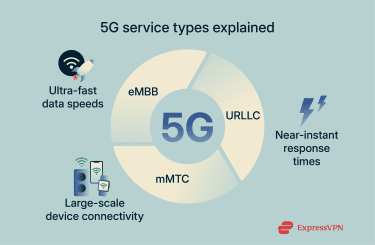 5G networks are designed around three main service categories that benefit from network slicing:
- Enhanced Mobile Broadband (eMBB): Provides high data speed and capacity for activities that move large amounts of data, such as streaming ultra-high-definition video, using virtual or augmented reality, or downloading large files.
- Ultra Reliable Low-Latency Communications (URLLC): Delivers fast and dependable connections for real-time applications where even small delays can cause problems, such as autonomous vehicles, remote surgery, or factory automation.
- Massive Machine-Type Communications (mMTC): Connects vast numbers of low-power devices, including sensors, meters, and tracking systems used in large-scale Internet of Things (IoT) networks that send small amounts of data but need to stay online continuously.
Connecting massive numbers of devices
5G networks are designed to support a much higher number of connected devices than previous mobile technologies, a capability known as high connection density.
This allows many devices, such as sensors, vehicles, and smart appliances, to communicate simultaneously within the same area without overloading the network. In practical terms, a 5G network can support up to 1 million connected devices per square kilometer, roughly ten times more than 4G networks.
Why is 5G important?
5G is an important evolution because it brings an array of improvements to current mobile networking technologies.
Faster speeds and lower latency
5G networks offer significantly higher data transfer rates and shorter response times than earlier mobile networks. Typical download speeds range from 100Mbps to over 1Gbps, while latency, the time it takes for data to travel between devices, can fall below 10 milliseconds.
These performance gains allow for real-time communication and high-bandwidth apps, such as cloud gaming and remote operation of equipment. Lower latency also supports tasks that require immediate feedback, including industrial control systems and telemedicine.
Foundation for IoT, AR/VR, autonomous vehicles, and smart cities
5G provides the connectivity needed for technologies that depend on continuous, reliable data exchange. Its ability to handle large numbers of connected devices with low latency makes it suitable for applications such as autonomous vehicles, real-time industrial control, and smart city infrastructure.
Security and privacy considerations
5G introduces major changes to how mobile networks handle security.
It encrypts both device identifiers and data traffic, which makes tracking and interception much harder than on 4G networks. It also uses a new authentication system, 5G Authentication and Key Agreement (5G AKA), that verifies the identity of both the device and the network before any data exchange takes place, which helps prevent fake base stations and unauthorized access.
5G security and privacy risks
These improvements come with new challenges, though. Because 5G depends on many small cell sites, it may allow for more precise location tracking. And since 5G relies on software and virtualization, there are potentially more vulnerable spots that attackers can exploit if not managed properly.
Where is 5G used?
5G’s high speed and low latency supports a growing number of applications across consumer, commercial, and industrial sectors.
- Mobile and home broadband: Some carriers use 5G for mobile networks and as a wireless alternative to fixed broadband through fixed wireless access (FWA), which provides home internet in areas without fiber or cable infrastructure.
- Industrial automation: Factories and logistics centers use private 5G networks to connect sensors, robots, and autonomous vehicles, enabling highly efficient smart factories.
- Smart cities: Cities use 5G to manage infrastructure more effectively, from adjusting traffic lights, to running drones that conduct infrastructure analysis.
- Entertainment: 5G's speed and capacity to handle large amounts of data makes cloud gaming services on mobile devices smoother and allows augmented reality (AR) and virtual reality (VR) experiences to feel more immersive and real-time
Further reading
- Types of internet connections explained
- How to choose the appropriate Wi-Fi settings on a router
- How to boost Wi-Fi signal at home
FAQ
How is 5G different from 4G?
5G operates across a much wider spectrum of frequencies and uses a mix of both traditional radio towers and small cell sites. Because of this, it’s faster, provides lower latency, and can connect more devices reliably.
What are the main benefits of 5G?
The main benefits of 5G are higher data speeds, lower latency, and greater network capacity. These features allow more devices to communicate at once, support real-time applications such as automation and remote control, and improve the overall reliability of wireless connections.
Is 5G safe?
Yes, according to the World Health Organization (WHO), there’s no evidence that 5G radio waves cause harm when exposure stays within international safety limits. These limits, set by the International Commission on Non-Ionizing Radiation Protection (ICNIRP), are conservative, capping public exposure at 137 V/m for low- and mid-band 5G, and 10 W/m² for high-band 5G.
Real-world measurements are far lower, typically 0.01 – 0.36 V/m in public areas. Even above these limits, the only known effect is mild tissue heating, similar to gentle warmth from sunlight.
How does 5G affect privacy and security?
5G improves network security through stronger encryption and authentication but also introduces new risks. Its use of many small cell sites can allow more precise location tracking, and its software-based systems create more points that must be secured.