Expressvpn Glossary
Data sovereignty

What is data sovereignty?
Data sovereignty refers to the principle that data is subject to the laws and regulatory requirements of the jurisdiction(s) where it is stored or processed. In cloud environments, that can be complicated because the same data may be stored, backed up, or processed in more than one location, so more than one legal framework may apply.
For example, a file uploaded in Germany might be replicated to servers in France, Ireland, or the U.S. If that happens, organizations may need to account for multiple sets of legal requirements, including cross-border transfer requirements, security controls, disclosure obligations, and incident reporting.
Data sovereignty vs. data residency vs. data localization
The following terms are closely related to data sovereignty but describe different legal and technical controls over data.
- Data residency: The geographical or physical location where data is stored (and sometimes processed). Companies may choose specific locations for operational reasons (such as lower latency or lower costs) or to meet contractual or regulatory obligations. Residency describes where data lives, but it doesn’t always mean the data must stay there.
- Data localization: Imposes a legal requirement that data must be stored, processed, or both within a specific jurisdiction. Unlike residency (which can be a business choice), localization is typically a legal mandate that restricts cross-border data flows.
In short, data sovereignty determines which country's laws apply to data; data residency determines where the data is stored (and sometimes processed); and data localization determines where the data must be stored and/or processed under law.
Risks of ignoring data sovereignty
Without knowing where user data is stored or processed, organizations can face several compliance risks.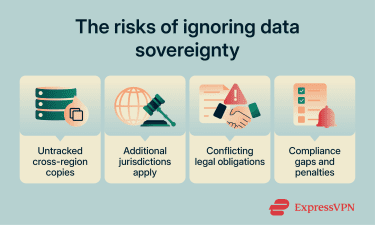
- Hidden data replication: Some cloud services replicate data for availability, backups, or disaster recovery, and replication may occur within a region or (depending on the service and configuration) across regions. If the full set of storage/backup locations and subprocessors isn’t understood and documented, organizations can overlook where additional legal requirements apply.
- Conflicting laws: Organizations may assume that data is governed by the laws of their own country or those of the provider’s headquarters. In practice, obligations can be shaped by where data is stored or processed and by which entity controls the service. This can create situations in which an organization must assess competing legal requirements (for example, transfer restrictions vs. a request for disclosure) and determine whether and how to respond lawfully.
- Regulatory violations: Cross-border transfers often trigger specific compliance conditions. If required transfer mechanisms, safeguards, or documentation are missing, organizations may face regulatory scrutiny, enforcement action, or restrictions on continuing the processing.
These risks are connected: incomplete visibility into where data is stored or processed can increase jurisdictional uncertainty, which can raise the likelihood of legal conflicts and compliance gaps.
Further reading
- Data sovereignty: What it is and compliance considerations
- What is data privacy and why it matters: A complete guide
- What is data encryption? How it works and why it matters
- End-to-end encryption: What it is and how it works
FAQ
Is data sovereignty the same as data residency?
Why do cloud services affect data sovereignty?
Because legal obligations can depend on where data is stored or processed (and sometimes on where the provider or customer is established), cloud architecture and deployment choices can affect which requirements apply.