Is WhatsApp HIPAA compliant?


WhatsApp is widely used among medical staff, but many healthcare professionals question whether it meets the Health Insurance Portability and Accountability Act (HIPAA) rules and regulations.
Healthcare communication sits at the intersection of privacy, security, and trust. Whether conversations happen through specialized clinical tools or everyday messaging apps like WhatsApp, understanding how each platform handles sensitive data and the protections in place is essential. At ExpressVPN, we explore how popular apps safeguard communication to help healthcare providers make informed decisions about digital privacy, especially in environments where security standards are critical.
In this guide, you’ll find an overview of WhatsApp’s security features, the considerations relevant to regulated environments, and potential risks when using it for patient information. We’ll also cover WhatsApp alternatives that offer compliant controls and audit tools, so you can choose options that fit your practice and protect patient privacy.
Note: This information is for general educational purposes and not legal advice.
Why WhatsApp isn’t HIPAA compliant
HIPAA requires strict controls over how patient information is shared and protected. In general, WhatsApp is a secure messaging platform, but it doesn’t meet these requirements. It also lacks the legal and technical safeguards needed for handling protected health information (PHI).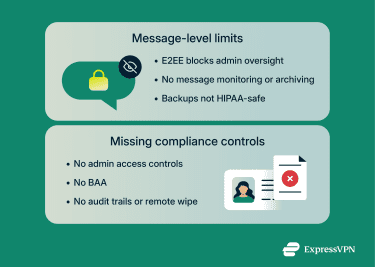
The following are the main HIPAA regulations that WhatsApp doesn’t live up to:
- Limited oversight due to end-to-end encryption (E2EE): WhatsApp employs strong E2EE, ensuring that only the sender and recipient can access message content. While this protects message privacy, it also means that administrators and compliance teams cannot review or archive conversations, which is a capability required under HIPAA for audit and accountability purposes.
- Insufficient account and access controls: HIPAA requires tools to manage user access, verify identities, and review communication history. WhatsApp’s consumer-oriented design doesn’t provide these administrative controls, which limits organizational oversight in regulated environments.
- No activity monitoring or device restrictions: Administrators can’t monitor user behavior, restrict devices, or prevent unauthorized sharing. If a phone is lost or someone accesses the app, patient information can be exposed without any way to detect or contain the breach.
- Inadequate protection for stored data: Messages are encrypted on-device and during transmission, providing strong protection. However, backups stored on services like iCloud or Google Drive don’t, by default, meet HIPAA’s requirements for secure storage environments. This distinction means patient information saved in these backups may be at higher risk from a regulatory perspective.
- No Business Associate Agreement (BAA): HIPAA requires a BAA, which is a legal HIPAA contract between a healthcare organization and any outside company handling PHI. WhatsApp doesn’t sign BAAs, reflecting its position as a consumer messaging platform rather than a HIPAA-covered service provider.
- Insufficient audit trails: HIPAA requires detailed logs showing who accessed PHI and when, with records retained for several years to support compliance reviews and investigations. WhatsApp doesn’t offer audit logs, and messages are device-based with limited retention, making compliance challenging.
- No remote deletion capability: WhatsApp doesn’t offer administrators the ability to remotely erase patient data from employee devices. Healthcare organizations need this ability to protect PHI when staff leave or when devices are lost or stolen.
- Breach reporting challenges: HIPAA’s Breach Notification Rule requires healthcare organizations to report any incident where PHI is exposed, often within strict timelines. Without proper monitoring or logging, WhatsApp makes it difficult for organizations to detect breaches or meet these reporting obligations.
Key features of HIPAA-compliant messaging apps
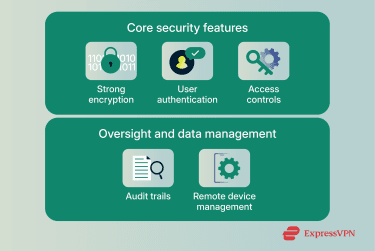 Messaging apps designed for healthcare use incorporate tools and technologies that help protect patient information according to HIPAA’s specific regulatory requirements. These features go beyond general cybersecurity measures to address the unique needs of regulated environments.
Core security standards for healthcare communication
To meet HIPAA standards, communication platforms typically include capabilities that support both the privacy and accountability of PHI throughout the communication lifecycle.
These tools must prevent data loss and support accountability by tracking who uses the system and what they do inside it. A compliant platform must also give administrators control over who can access patient information and how that information is handled.
A compliant messaging app should include the following protections:
- Encryption: Ensures that messages are protected both in transit and at rest. While many consumer apps like WhatsApp also use encryption, HIPAA-compliant platforms implement it alongside additional measures.
- Authentication: Confirms the identity of users logging in, helping to prevent unauthorized access to sensitive data.
- Access controls: Allow administrators to decide who can view specific information, reducing unnecessary exposure within the healthcare team.
- Audit trails: Generate detailed logs of who accessed PHI and when, supporting compliance audits and helping teams spot unusual behavior.
- Remote data management: Allow administrators to lock or wipe data if a device is lost or stolen, preventing patient information from being exposed.
Together, these messaging app features can help healthcare organizations meet HIPAA’s technical safeguards and administrative requirements, supporting secure, compliant communication within clinical workflows.
Alternatives to WhatsApp for healthcare providers
Below are messaging and communication platforms commonly used in healthcare settings that are designed with HIPAA-specific safeguards in mind. These apps include protections such as secure logins and controlled device access. They also fit into clinical routines by supporting team messaging, patient updates, and file sharing in a safe environment, all while following professional netiquette standards.
- TigerConnect: Offers secure logins that verify each user, device controls, and administrative monitoring tools.
- OhMD: Provides encrypted messaging, controlled access, and patient communication management.
- Spruce Health: Offers secure messaging, patient portals, and oversight features for team coordination.
- Spok: Delivers encrypted communication, device restrictions, and compliance-focused workflow support.
- Paubox: Provides E2EE, secure storage, and BAA support.
Feature comparison and compliance levels
Below is a simple table comparing the alternatives based on feature and compliance differences:
| App name | Core security | Administrative controls | Advanced features |
| TigerConnect | Secure logins, device verification, encrypted messaging | Admin monitoring, device controls | Shared inboxes, reporting |
| OhMD | Encrypted messaging, controlled access | Basic admin controls | Patient communication management |
| Spruce Health | Secure messaging, encrypted communication | Oversight features for team coordination | Patient portals, team workflow tools |
| Spok | Encrypted communication, device restrictions | Workflow-focused compliance | Telehealth support, workflow management |
| Paubox | E2EE, secure storage | BAA support, device access controls | Limited advanced features |
All compliant platforms meet required data protection rules, but higher-tier services may offer stronger reporting, deeper device control, or additional communication tools. In practice, this lets medical teams choose the level of security and functionality that best supports their workflow.
FAQ: Common questions about WhatsApp HIPAA compliance
Does WhatsApp violate HIPAA?
WhatsApp is a consumer messaging app and is not designed, marketed, or positioned to meet the Health Insurance Portability and Accountability Act (HIPAA) requirements. While it uses strong end-to-end encryption to protect messages in transit, it doesn’t provide the administrative controls, audit capabilities, or Business Associate Agreement (BAA) that healthcare organizations typically need when handling protected health information (PHI).
What messaging app is HIPAA compliant?
Several apps meet Health Insurance Portability and Accountability Act (HIPAA) requirements; popular choices include TigerConnect, OhMD, and Spruce Health. These platforms use secure logins, controlled access, and features that verify data is handled in a way that meets HIPAA’s specific compliance standards.
What are the implications of using WhatsApp in healthcare?
Using WhatsApp for patient-related communication may introduce privacy and compliance risks in healthcare settings. While the app offers strong encryption, it doesn’t include admin controls such as centralized oversight, device management, or long-term audit logging required to comply with the Health Insurance Portability and Accountability Act (HIPAA). In some cases, this can increase the likelihood of unintended access or data exposure. If protected health information (PHI) is involved, such incidents may create regulatory or legal obligations for healthcare organizations under HIPAA.
Can healthcare professionals communicate via messaging apps?
Yes, healthcare professionals can use messaging apps if the platform meets Health Insurance Portability and Accountability Act (HIPAA) requirements and is implemented appropriately within the organization’s policies. This typically includes protections for data in transit and at rest, access controls, audit capabilities, and the ability to establish a Business Associate Agreement (BAA) where required.
What to do if a patient requests to use WhatsApp?
Healthcare professionals can inform patients that WhatsApp is a consumer messaging app not specifically designed to meet the security and privacy requirements outlined by the Health Insurance Portability and Accountability Act (HIPAA). To help protect sensitive medical information, it’s advisable to offer patients a communication method that complies with HIPAA standards.
What makes a messaging app HIPAA-compliant?
A messaging app considered compliant with the Health Insurance Portability and Accountability Act (HIPAA) typically uses strong encryption, restricts access to authorized users, provides audit logs, and includes a signed Business Associate Agreement (BAA) to ensure proper handling of protected health information. Compliance also depends on how the app is used within an organization’s policies.
Should healthcare professionals use a VPN for patient communication?
A virtual private network (VPN) can add an extra layer of protection by encrypting traffic between your device and the VPN server. This added layer of protection is especially valuable when healthcare professionals access messaging apps or patient data over unsecured or public Wi-Fi networks, reducing the risk of interception by unauthorized parties. A VPN enhances network security, but it doesn’t replace the need for Health Insurance Portability and Accountability Act (HIPAA) compliant apps and their built-in safeguards for protecting patient information.
Take the first step to protect yourself online. Try ExpressVPN risk-free.
Get ExpressVPN












 Support Center
  FAQ
FAQ  VPN Setup Tutorials