 Celebrate with up to 80% off
What is a sugar daddy scam, and how does it work?



A sugar daddy typically refers to someone who offers financial support to another adult, often in exchange for companionship or some form of relationship. These arrangements can vary widely, and many begin online, where it isn't always easy to tell whether an offer is genuine.
Scammers may imitate this dynamic to make fake offers, payment requests, or overpayment schemes seem more believable. In scam scenarios, the offer of financial support is used to introduce requests for money, personal information, or account access from the target.
While the scam often targets people considering or engaging in sugar dating arrangements, the same tactics can appear in any unsolicited online interaction involving promises of money.
What is a sugar daddy scam?
A sugar daddy scam is a type of romance scam that commonly takes place on dating apps and social media platforms. It involves someone posing as a wealthy or generous individual who uses the promise of financial support to build interest, maintain an interaction, and gain money, personal information, or access to the target's financial accounts.
Why scammers use the sugar daddy angle
Scammers use the sugar daddy angle because financial support is already part of what a genuine sugar daddy arrangement may involve. If the interaction begins with the idea that one person may send money or provide help, payment-related requests can seem less unusual than they would in another online conversation.
The setup can also make the situation harder to assess clearly. A generous or personal offer may create hope, especially if it appears at a time when support would be useful. That can make unusual requests feel connected to the arrangement rather than immediately suspicious.
How do sugar daddy scams unfold?
While each scam can look different, many follow a similar pattern.
1. An unexpected offer appears
The scammer typically reaches out directly or responds to something the target has posted online. The scammer presents themselves as wealthy, generous, or interested in providing financial support.
2. The offer starts to feel personal
The conversation becomes more tailored over time. The scammer might mention helping with bills, providing regular support, or offering companionship. This can make the interaction feel more convincing, especially if it appears to match the person's situation.
3. A complication gets introduced
Instead of sending money, the scammer gives a reason why they can't. They might mention a processing issue, verification step, fee, delay, or other barrier. The conversation then turns toward the scammer needing money, gift card codes, account details, verification codes, or another form of help from the target.
4. The requests continue or the scammer disappears
If the recipient sends money, shares account details, or provides verification codes, the promised support often doesn't arrive. The scammer may introduce new delays, ask for more money, or stop responding.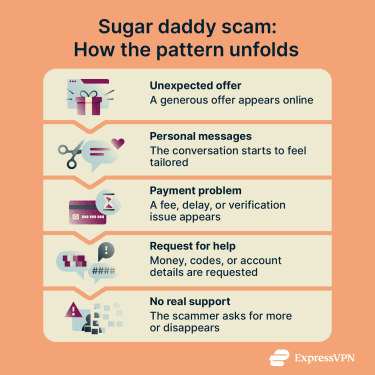
Common sugar daddy scam scenarios
Sugar daddy scams can take different forms, but many rely on the same basic tactics. Here are some examples.
Fake check or overpayment scam
This scenario usually appears after some trust with the recipient has been built. The scammer claims they're ready to send an initial payment, but the payment later turns out to be fraudulent.
At first, money may appear in the target's account. The scammer then follows up with another request. They may say they sent too much money by mistake, need help covering a fee, or want part of the money sent elsewhere as a "favor."
This is a common overpayment scam tactic: A fraudulent payment appears to arrive, and the target is asked to send part of it back. Later, the payment is reversed. The full amount is removed from the account, but any money the victim sent is usually not recovered.
The "account setup" request
In this scenario, the scammer asks for login details, verification codes, or access to an account or app, presenting the request as part of setting up payments or transfers.
The request may sound routine, but once these details are shared, they can be used to take over the target's own accounts, bypass security checks, or carry out unauthorized actions in the target's name. This could involve financial accounts, email, social media profiles, or payment apps.
Unlike fake payment scenarios, there is no fraudulent payment to reverse. Instead, the scam relies on gaining access to accounts or sensitive information directly, which can lead to financial loss or account misuse.
The crypto "investment" setup
In this situation, the scammer presents cryptocurrency as part of the sugar daddy arrangement. They may claim they want to grow the target's allowance, invest on their behalf, or send support through a crypto platform.
When the target tries to access or withdraw the supposed funds, the scammer introduces another barrier, such as a "processing fee," "tax payment," or "wallet verification fee." The fee is framed as the final step before the money can be released.
After the extra payment is sent, the scammer may stop responding. Both the original payment and the additional fee can be lost. Because cryptocurrency transactions are generally difficult to reverse or trace, recovering the money is unlikely.
Why sugar daddy scams can be hard to spot
Sugar daddy scams can be difficult to spot because they don't always look suspicious at first. The conversation may develop gradually, with friendly, consistent, or personalized messages that make the interaction feel credible over time.
The requests can also seem connected to the arrangement. Fees, transfers, account details, or verification steps may be presented as part of setting up payments, rather than as something unusual or out of place.
Online platforms can make this harder to assess. Profiles, images, and personal details may be reused or taken from elsewhere, making it difficult to confirm who is actually behind the account.
As the interaction continues, requests may become more frequent or specific while the tone of the conversation stays the same. This can make it harder to spot a clear turning point between a normal interaction and a scam.
Red flags of a sugar daddy scam
Early red flags of a sugar daddy scam are usually subtle. One detail on its own might not prove anything, but several signs together can point to a scam.
Some common warning signs include:
- They promise money upfront without building trust first: An offer of financial support very early in the conversation can be a warning sign, especially if it comes before any real trust or context has been established.
- They ask detailed questions about financial circumstances: Questions about money problems, debts, or financial struggles can seem like genuine concern. Scammers may use this information to shape the offer and make it feel more persuasive.
- Their story doesn't fully add up: Details about their job, lifestyle, or availability may feel vague, inconsistent, or overly polished. When questioned, they may avoid clear answers or change details over time.
- They push for specific payment methods: Requests involving gift cards, wire transfers, cryptocurrency, or other hard-to-reverse payment methods can be a warning sign, especially if there is pressure around how money should be sent.
- They move the conversation off-platform quickly: Soon after connecting, they may ask to switch to another messaging app, where there may be less oversight and fewer platform protections.
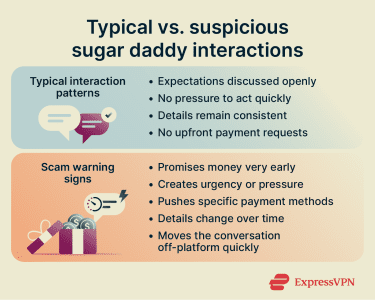 These signs don't always appear all at once. They often show up gradually, blending into what feels like a normal interaction. That's why the overall pattern matters more than any single detail.
Why sugar daddy scams can be difficult to walk away from
Sugar daddy scams can be difficult to leave because they often mix financial hope with emotional pressure. The offer may appear at a moment when support would be useful, which can make the victim want the situation to be real.
Scammers can also create a sense of progress. A promised payment, a pending transfer, or a supposed final step can make it feel like the situation is close to being resolved. That can make each new request seem like the last obstacle, rather than another warning sign.
There may also be embarrassment or confusion once doubts appear. Someone who has already shared information or sent money may keep responding because they want answers, reassurance, or a chance to recover what was lost. Scammers can use that uncertainty to continue the interaction.
This is why slowing down can help. When the situation is viewed outside the pressure of the conversation, repeated delays, changing explanations, and requests for money or account access are easier to recognize.
Reducing the risk of sugar daddy scams
A few precautionary steps can help reduce the risk of becoming involved in a sugar daddy scam. Many of the same safety habits recommended for dating apps also apply here, especially when conversations with unfamiliar people begin involving money early in the interaction.
- Verifying the profile: A reverse image search can help check whether a profile photo appears under different names or on unrelated accounts. Other warning signs include reused details, inconsistent profile information, or accounts that seem to be deleted and recreated.
- Being cautious with payment-related requests: Requests to cover a fee, refund part of a payment, or use a specific payment method should be treated carefully, especially when there is urgency or emotional pressure.
- Keeping financial details private: Account information, login details, verification codes, and other sensitive information shouldn't be shared with someone online, even if the interaction feels genuine.
- Slowing the conversation down: If details don't add up or the timeline keeps changing, taking a break can make it easier to review what has been said and decide whether the interaction still feels safe.
What to do after a sugar daddy scam
After a sugar daddy scam, quick action can help limit the damage, especially if money, financial accounts, or personal information were involved.
Keeping a record of the interaction
Before blocking the account, any remaining information should be saved. This can include the profile, messages, usernames, contact details, payment information, screenshots, timestamps, and payment confirmations.
A clear record can make it easier to report the incident, contact a bank or payment provider, file a formal complaint, or explain what happened later, especially if the conversation took place over several days or across different platforms.
Stopping all communication
Once relevant evidence has been saved, communication should stop. This can include blocking the account on the original platform, blocking related social media accounts, and avoiding follow-up messages from new accounts.
It can be tempting to keep responding in the hope of recovering lost money or getting answers. In most cases, continued communication doesn't lead to a resolution and may create more opportunities for manipulation or additional fraudulent requests.
Protecting financial and other accounts
If money has been sent or account access has been shared, contacting the associated bank or payment provider as soon as possible may help limit further damage. They may also be able to review the transaction and explain whether any recovery options are available based on the payment method used.
If passwords, verification codes, or login access were shared, affected accounts and settings should be reviewed. Email, banking, and payment-linked accounts are usually the best place to start because they can be used to reset passwords, move money, or access other services.
Passwords should be changed, and previously used passwords shouldn't be reused. Where possible, two-factor authentication (2FA) should be enabled so that account access requires an additional verification step. Reviewing recent account activity can also help identify unauthorized changes or suspicious activity.
Reporting the scam
Reporting the incident can help flag the account and support ongoing investigations. When submitting a report, details such as usernames, payment methods, screenshots, or copies of messages may be requested. Having this information ready can make the process smoother and reduce the need to gather evidence later.
Reporting options vary by location. In the U.S., reports can be submitted through ReportFraud.ftc.gov and IC3.gov. In the U.K., reports can be submitted through Report Fraud (reportfraud.police.uk).
Recognizing follow-up scams
After a scam, victims are sometimes contacted again. The same scammer might use a different account, or another person might claim they can help recover lost money.
These messages can sound official or urgent, but they often lead to new requests for fees, account access, or personal information. Any follow-up contact involving payment or account access should be treated cautiously.
FAQ
Can the victim get their money back after a sugar daddy scam?
Can a sugar daddy scam happen without money being sent?
Why do sugar daddy scammers ask for gift cards?
Should I ever deposit a check from a stranger online?
Are sugar daddy apps safe to use?
Is every sugar daddy online a scammer?