Expressvpn Glossary
Telecommunications equipment
What is telecommunications equipment?
Telecommunications equipment refers to physical hardware (along with any embedded or integral software) used to transmit and receive voice, data, and video over communications networks. It includes carrier-deployed systems across wired, wireless, and optical networks, as well as enterprise and end-user devices that provide access, routing, or network operation functions.
Its primary function is to provide the hardware and embedded control functions that enable network communications. Telecommunications equipment is distinct from telecommunications services, though some network functions that were once delivered only by dedicated hardware may now also be virtualized or software-defined.
How does telecommunications equipment work?
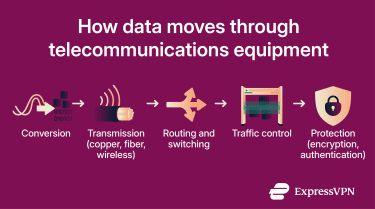
In practice, telecommunications equipment typically performs these functions:
- Signal conversion: Transforms voice, text, or video into electrical, optical, or radio signals suitable for transmission, and converts received signals back into usable information.
- Transmission over a medium: Adapts signals to travel over copper, fiber-optic links, or wireless radio frequencies, including any required modulation, coding, and related transmission processing.
- Traffic routing and switching: Uses addressing information and protocol rules to forward traffic to the correct destination across one or more network segments.
- Resource and quality control: May manage sessions, prioritize traffic, and allocate network resources to maintain performance and support service quality targets.
- Security: May support or enforce functions such as authentication, encryption, access control, and secure signaling, depending on the device's and network's roles.
Types of telecommunications equipment
Depending on its role in a communications network, telecommunications equipment is commonly classified as:
- Core network equipment: Routes and switches traffic across the backbone or core network. Examples include core routers and carrier-grade switches.
- Access equipment: Connects end-user locations and devices to the provider network. Examples include modems, optical network terminals, and optical network units.
- Optical network equipment: Transmits, multiplexes, monitors, and in some cases amplifies data over fiber-optic links at high capacity. Examples include optical transceivers and dense wavelength division multiplexing (DWDM) systems.
- Mobile network equipment: Provides wireless network connectivity for mobile devices. Examples include base stations and small cells.
- Voice communications equipment: Supports voice calling and real-time voice routing. Examples include Voice over Internet Protocol (VoIP) gateways, private branch exchange (PBX) systems, and session border controllers.
Why is telecommunications equipment important?
Telecommunications equipment is important because it provides the infrastructure and network functions that enable internet and mobile connectivity and support the movement of voice, data, and video traffic across networks.
It directly affects network performance and reliability, including latency, availability, and service quality (such as error rates and packet loss), thereby helping maintain accurate and dependable communication.
This supports essential functions, including digital services, business communications, remote collaboration, and emergency communications. Many sectors that rely on continuous connectivity (such as finance, healthcare, and other critical infrastructure) depend on communications networks and the equipment that runs them to maintain service continuity at scale.
Where is telecommunications equipment used?
Telecommunications equipment is used anywhere communications traffic needs to be transmitted, routed, or managed. This includes internet service provider (ISP) networks and data centers, such as cloud platforms and hosting facilities, as well as mobile networks at cell sites (base stations) and provider edge or aggregation sites (such as central offices and points of presence).
It's also widely used in enterprises, campuses, and branch offices, where it supports systems such as IP PBX platforms and wide area network (WAN) infrastructure.
In homes and small businesses, it includes equipment such as Wi-Fi routers, residential broadband devices (like modems or optical network terminals), and in-building networking devices. Telecommunications equipment is also used in industrial and Internet of Things (IIoT/IoT) deployments, including connected sensors and monitoring stations.
Risks and privacy concerns
Telecommunications systems are often treated as critical infrastructure and carry large volumes of potentially sensitive traffic, making them frequent targets for cyberattacks.
Common risks include software and firmware vulnerabilities, especially in network devices and their management interfaces. Weak access controls (such as default credentials or poorly secured administrative accounts) can enable unauthorized access to network systems.
Supply-chain risks can also introduce compromised components or software, including tampered hardware, malicious updates, or insecure third-party dependencies.
Privacy risks can persist even when message content is encrypted. Network and traffic metadata (for example, source and destination identifiers and timing information) can still be observed and used to infer communication patterns or user activity.
Further reading
- What is routing, and why does it matter in networking?
- How to choose a router: Top mistakes to avoid and pro buying tips
- How does the internet work?
- Types of internet connections explained
- Network architecture: Building secure and modern networks