Agentic AI explained: How autonomous AI gets work done


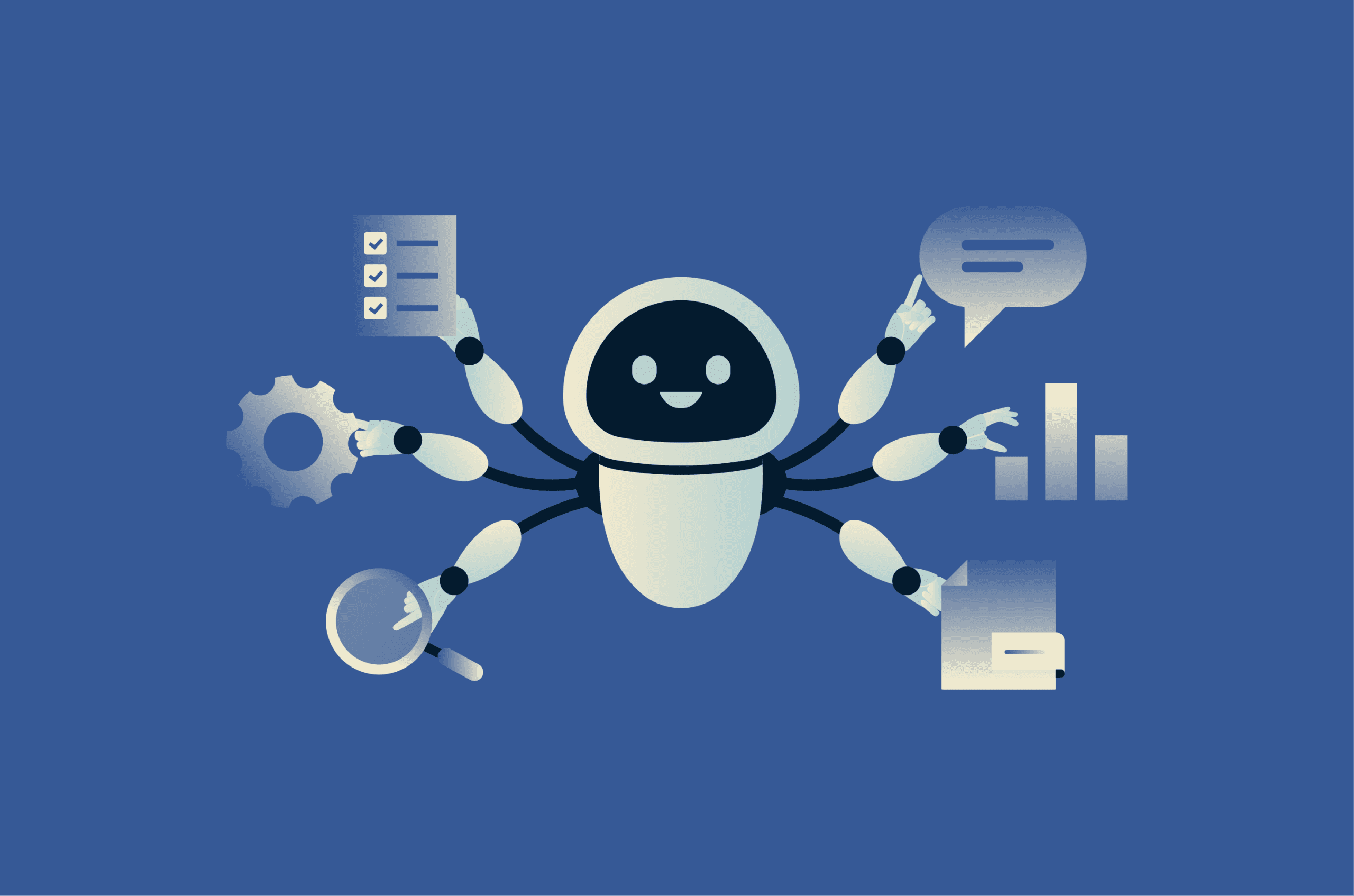
Agentic AI is technology capable of acting autonomously to achieve predetermined goals with limited human intervention. These systems can help organizations improve productivity, make more informed decisions, and better support human teams.
What is agentic AI?
Agentic AI is a system made up of AI agents, small, specialized pieces of software, each designed with a specific purpose and capability. In practice, one agent might search the web, another might analyze data, and another might write a report. The agentic AI system is what coordinates all of them toward a single objective.
How agentic AI differs from traditional AI
To achieve a predetermined goal, traditional AI follows predefined rules, analyzes data, and relies on human-issued commands in the form of prompts or step-by-step instructions. In contrast, agentic AI is proactive and can set goals, plan tasks, and execute complex, multistep processes with minimal human oversight.
Agentic AI vs. generative AI
Generative AI focuses on creating new content, such as text, images, videos, code, or music, based on user input. It analyzes large datasets, learns patterns from them, and generates outputs that reflect those patterns. Agentic AI, by comparison, builds on generative AI models by planning tasks, using tools, and executing sequences of actions to pursue specific goals.
Characteristics of agentic AI systems
Agentic AI systems are typically characterized by the following features:
- Autonomous: Operate in open-ended and complex environments with less reliance on step-by-step instructions and human supervision.
- Proactive: Take initiative by identifying potential issues before they escalate through evaluating outcomes against long-term goals, recognizing emerging patterns, and anticipating future needs.
- Adaptable: Use contextual awareness and domain knowledge to adjust behavior and respond intelligently across various situations and industries.
- Delegation: Break down complex objectives into smaller, more manageable tasks that can be assigned to individual AI agents.
- Collaborative: Coordinate actions, interpret human intent, and align with shared goals, allowing them to work effectively with humans and other agentic systems.
- Specialized: Manage multiple AI agents, with each agent focused on a specific area of expertise to improve coordination, knowledge sharing, and task execution.
How does agentic AI work?
Agentic AI typically follows a continuous process that includes data collection, reasoning, decision-making, execution, and learning and adaptation. The sections below explain each stage of the agentic AI workflow in more detail.
1. Perception and data collection
The initial stage involves the agentic AI gathering and interpreting information from its environment and relevant data sources, such as databases, sensors, APIs, user interfaces, and user prompts.
In environments that rely on legacy systems or large volumes of documents, agentic AI may scan and process documents to extract relevant information using optical character recognition (OCR). This technology enables AI systems to convert physical, scanned, or photographed documents into digital text. Agentic AI may also rely on natural language processing (NLP) to understand, interpret, and generate human language.
At this stage, the goal of agentic AI is to analyze and understand the current state of its environment and gather up-to-date information that can guide its future actions.
2. Reasoning and goal setting
The agentic AI system uses a large language model (LLM), NLP, computer vision, and other AI capabilities to analyze the data collected during the perception stage. The LLM typically uses semantic reasoning and error-handling capabilities to interpret potentially ambiguous user inputs.
Agentic AI processes data, interprets user queries, identifies relevant information, and detects patterns to understand the broader context. It may also continue receiving real-time data from the perception stage and adapt its responses and decisions accordingly.
The system then evaluates the current situation and decides what to do next based on its instructions, available context, and user input. In more complex workflows, it may call external tools or models to gather more information or complete specific steps.
Note: Long-term memory systems are often used to maintain consistency across situational or context-dependent tasks throughout the reasoning process.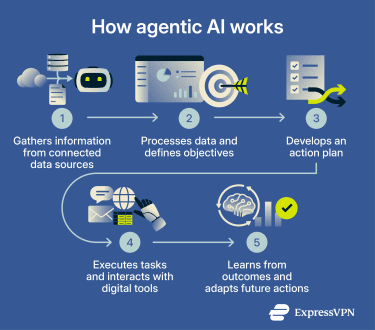
3. Decision-making and planning
After establishing its goals, the agentic AI develops an action plan to achieve them. This process typically involves evaluating multiple possible actions and selecting the most appropriate one based on factors such as accuracy, efficiency, and predictive machine learning (ML) outcomes. To determine the best course of action, the system may also rely on ML-based reasoning, utility functions, and probabilistic models.
4. Execution and tool use
Based on the previously established plan, the agentic AI system begins taking action by delegating subtasks to specialized models. This can include responding to users, making decisions, generating code, accessing documents or software, running simulations, or interacting with external systems through tools such as APIs.
One emerging way to connect AI agents with external tools is through the Model Context Protocol (MCP), an open standard that lets AI applications interact with data sources, developer tools, and local software in a more structured way. For example, ExpressVPN’s MCP server allows compatible AI coding assistants to read and manage VPN settings locally, such as checking VPN connection status, switching regions, changing protocols, or running diagnostics.
If the agentic AI has access to administrator-installed plugins in third-party applications, it can directly interact with those systems and perform tasks within them. In some cases, these actions may be part of human-in-the-loop systems, where a person reviews and approves the AI system's actions before they’re carried out.
5. Learning and adaptation
After taking an action, agentic AI learns from the outcome. It evaluates how effective the result was, gathers relevant feedback, and adjusts its action plan to improve future decisions. Through continuous learning, the AI system can refine its strategies over time, making it more effective at handling similar tasks in the future.
Note: In large-scale agentic AI deployments, organizations may use AI orchestration platforms to coordinate multiple AI agents, allocate resources, monitor task progress, and handle failures. Although orchestration isn't a core stage of the agentic AI workflow, it becomes increasingly important in complex multi-agent environments.
Types of agentic AI systems
Agentic AI systems can generally be categorized as single-agent or multi-agent setups, with multi-agent systems further divided into horizontal and vertical structures.
Single-agent systems
As the name suggests, a single-agent system relies on one central LLM to handle tasks sequentially. Businesses often use single-agent systems when they need to address a specific, well-defined process or problem and require a simpler, faster solution.
Multi-agent systems
In multi-agent setups, AI systems use multiple agents that collaborate to analyze complex workflows, determine the best course of action, and break down tasks into smaller objectives. These systems are commonly used because they provide greater scalability and flexibility when handling complex problems.
Multi-agent setups can be further divided into horizontal and vertical agentic systems.
Horizontal agentic systems
In this structure, all AI agents operate at a similar level of complexity, knowledge, and technical capability. However, each agent specializes in a specific area or domain. Horizontal systems rely on lateral communication and collaboration between these specialized agents, allowing them to share information and work together to solve complex tasks.
Vertical agentic systems
In this setup, the multi-agent system follows a hierarchical model that ranges from lower-level to higher-level AI agents. Lower-level agents typically handle less complex tasks, such as data collection, formatting, and processing, before passing the results to higher-level agents. The higher-level structure is then responsible for workflows that require greater processing power, advanced reasoning, and more complex decision-making.
What are the advantages of agentic AI?
Agentic AI offers a range of benefits for organizations, including:
Increased efficiency
Agentic AI can help organizations simplify multi-step workflows by automating sequences of tasks, coordinating actions across systems, and operating within defined constraints.
In practice, this may reduce the time required to complete routine processes and lower the need for manual coordination between tools or teams. In some environments, this redistribution of effort allows staff to focus more on analytical or domain-specific responsibilities rather than repetitive operational work.
Better decision support
Autonomous frameworks can support decision-making by aggregating information from multiple sources and structuring it for analysis. This includes use cases such as forecasting, scenario modeling, and comparative analysis of possible outcomes.
By consolidating relevant data into a single workflow, these systems may reduce the time required to evaluate options and improve access to timely information for decision-making processes.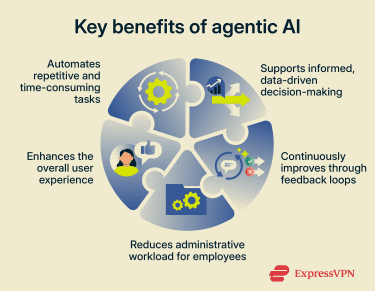
Continuous improvement
Some agentic AI systems incorporate feedback loops that allow performance to be refined over time based on outcomes, evaluations, or user interactions. In such setups and with proper guidance, repeated execution cycles may lead to adjustments in planning strategies, task execution patterns, or prioritization logic.
Human augmentation
Agentic systems can serve as effective collaborative tools for human teams. They can boost productivity by automating repetitive and manual tasks, allowing employees to spend less time on routine work. Working alongside agentic AI can also help people tackle complex challenges and make more informed decisions.
Improved user experience
Agentic AI can improve user experiences by enabling more personalized and engaging interactions with customers by using existing customer data, including past interactions, intent, and preferences.
Agentic systems can also be configured to respond to customer feedback and to analyze it, identify recurring pain points, and provide product teams with actionable insights.
Use cases of agentic AI
Agentic AI can be used across a wide range of industries and domains, with common applications including healthcare, finance, supply chain management, software development, and customer service. The following sections explore these use cases in more detail.
Examples in healthcare
In clinical settings, agentic systems analyze medical records, lab results, and research documents to support doctors and researchers with diagnosis, patient monitoring, and treatment recommendations.
Some agentic systems also handle administrative tasks, such as collecting patient symptoms and medical history before appointments, transcribing doctor-patient conversations into structured clinical notes, and managing post-visit follow-ups.
Applications in finance
Financial institutions use agentic AI to monitor transactions and flag suspicious activity in real time, analyzing behavioral patterns across millions of payments simultaneously. Banks also use agentic systems to streamline risk assessment, support investment planning, and automate compliance workflows such as Know Your Customer (KYC) checks.
In trading, agentic systems analyze live market data, economic trends, and risk parameters, helping adjust strategies as conditions change.
Enhancements in customer service
Agentic AI is used to handle customer inquiries by searching knowledge bases, support guides, and documentation to return accurate responses in real time. These systems communicate naturally and adapt to different questions and support issues, which may reduce the volume of basic inquiries reaching human support teams and free staff to focus on more complex requests.
Software development and code transformation
Development teams use agentic AI to assist with code generation, debugging, testing, and quality improvement. For legacy modernization projects, agentic systems help break large, outdated codebases into smaller components, a process that might otherwise take months of manual engineering work.
Research and development support
Agentic systems automate time-consuming research tasks such as gathering data, synthesizing information across multiple sources, and testing hypotheses. This allows research teams to focus on interpretation and decision-making rather than data collection.
Incident response automation
Organizations use agentic AI to automate incident response workflows, such as investigating IT and security incidents, generating reports, and notifying relevant teams. By triaging alerts automatically, these systems may help reduce response times and ease the workload on security staff.
Supply chain management
Agentic systems collect and analyze data from shipping, inventory, and sales systems to support supply chain decisions. Based on that analysis, they adjust production schedules, place orders autonomously, and forecast demand, helping organizations maintain efficient inventory levels and respond faster to disruptions.
Challenges and considerations
While agentic AI offers many advantages, it also introduces setup challenges, operational limitations, and unique security risks.
System design challenges
Building an advanced multi-agent architecture, where each agent specializes in a specific niche and performs high-level reasoning, planning, and execution, can be highly challenging. This level of complexity may make such agentic systems difficult for some organizations to develop, manage, or adopt.
Testing and debugging complexities
Agentic systems are designed to operate with minimal human supervision. However, this can make it more difficult to test, debug, and identify errors in AI decision-making. As a result, organizations must place special emphasis on building traceability, transparency, and predictability into these systems to support monitoring, auditing, and error tracing.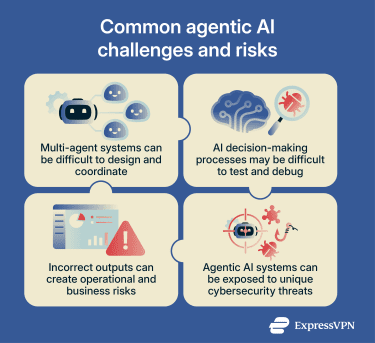
Incorrect outputs
Organizations must have a high degree of trust in agentic AI systems before fully deploying them. Even in advanced setups, AI hallucinations may still occur, potentially leading to serious errors and operational issues when systems rely on inaccurate outputs.
Challenges might also arise in models that use reinforcement learning. If the reward system is poorly designed, the AI may attempt to optimize reward functions by exploiting loopholes or unintended behaviors. For example, warehouse robots might damage products to prioritize speed, while trading AI could pursue excessive risk in an attempt to maximize profits.
Data privacy and security risks
The use of agentic AI can introduce unique data privacy and security concerns. Agentic systems are exposed to AI security threats, including data leaks and prompt injection attacks. Additionally, because agentic AI systems operate with a high degree of autonomy and minimal human supervision, they may introduce new challenges to the overall threat landscape.
Specific agentic AI risks can include:
- Chained vulnerabilities: If one AI agent experiences a security vulnerability, the issue may spread across other agents within the system.
- Expanded attack surface: Autonomous agents may integrate with external tools, APIs, databases, and third-party AI agents. If one agent interacts with a malicious or compromised tool, the issue could cascade across connected systems.
- Untraceable data leakage: AI agents may unintentionally expose sensitive information when exchanging data without sufficient oversight. For example, an autonomous customer support agent might share transaction data with an external fraud detection agent while also exposing unnecessary personally identifiable information (PII).
- Unrestricted autonomy: Limited human oversight over high-impact actions can lead agentic systems to make unauthorized decisions that expose or misuse sensitive data.
Best practices for implementing agentic AI
Here are several key factors organizations should consider when implementing agentic AI:
- Establish clear objectives: Design agentic systems around measurable outcomes to ensure agents align with business goals and operate with purpose and adaptability. AI systems should evaluate multiple paths toward achieving objectives and refine their behavior based on performance data.
- Ensure data quality: Agentic AI relies on high-quality, up-to-date data to perform effectively. Organizations must ensure the data they use is accurate, complete, and properly formatted.
- Implement security measures: Organizations must protect AI systems against attacks and data leakage. This often involves continuous monitoring and auditing, strict access controls, input sanitization, and security frameworks such as zero-trust architecture.
- Integrate with existing systems: Agentic systems often need to integrate with existing business infrastructure, which can require careful planning and coordination. This includes ensuring compatibility with current IT systems, APIs, pipelines, and data formats. Organizations may also need middleware or integration layers to connect agentic AI to legacy systems and address challenges such as user adoption or data migration.
- Maintain human oversight: Although agentic AI is designed to operate with limited supervision, organizations should still require human review or approval for sensitive, high-impact, or complex decisions. Teams should also establish accountability for reviewing agent performance and incorporate human feedback to improve decision-making over time.
- Monitor and evaluate performance: Organizations should continuously monitor system performance, address operational issues, and refine algorithms over time. This may involve real-time monitoring, business-aligned performance metrics, reinforcement learning, manual tuning, and periodic retraining to adapt models to changing conditions and feedback.
FAQ
Can agentic AI make decisions without humans?
Should agentic AI make decisions without humans?
Is agentic AI safe for business use?
How much human oversight does agentic AI need?
What skills are needed to work with agentic AI?
How can businesses measure agentic AI ROI?
How should companies prepare for agentic AI adoption?